
3D rendering cost is one of the key factors for companies that are looking to invest in product development and engineering visualization services. The high-end rendering process allows converting the CAD models into high-quality visual images that enable manufacturers and engineers to estimate the performance of the products prior to actual production. When discussing the costs of 3D rendering, there are certain technical aspects that should be considered in detail.
Understanding 3D Rendering Cost
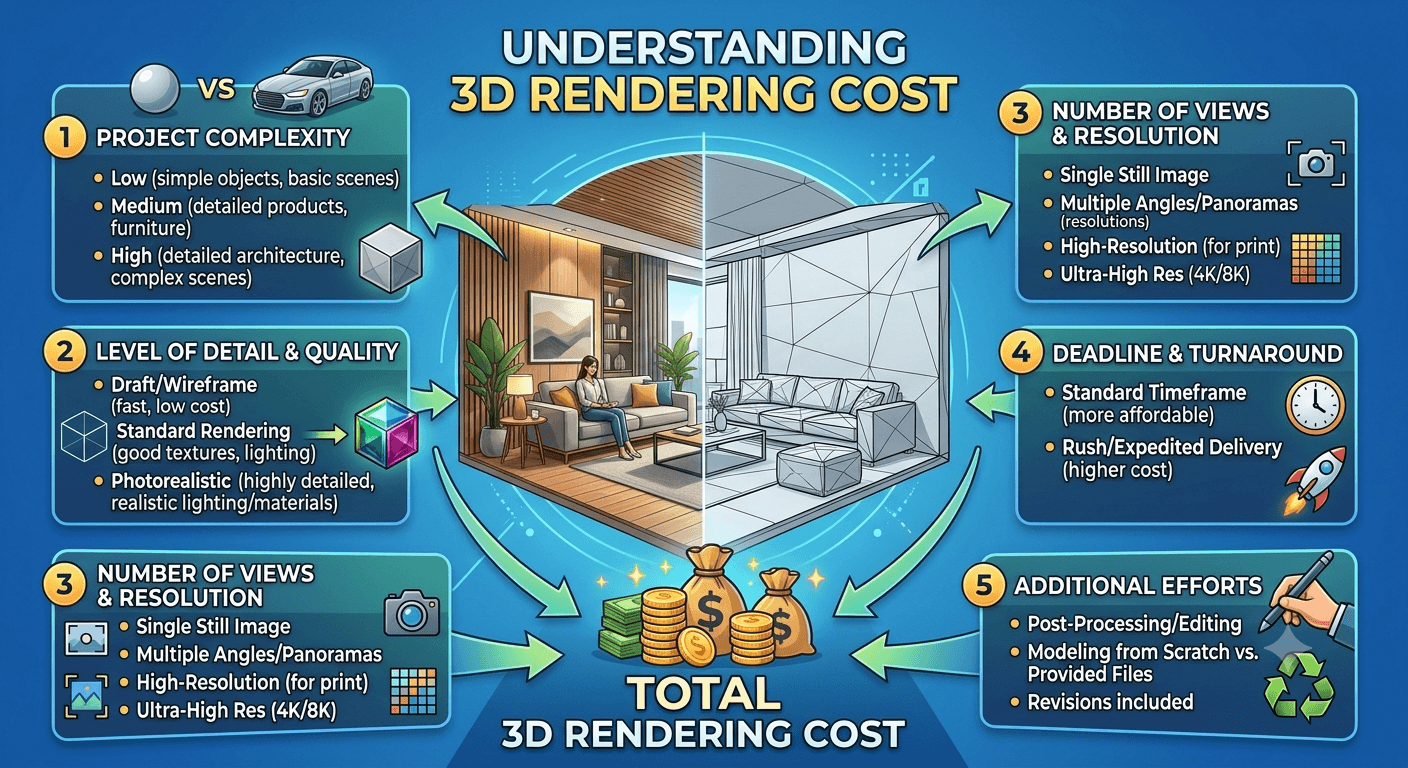
“3D rendering cost refers to the overall investment required to produce realistic digital images from engineering or CAD models. The price will depend on project requirements, the quality of rendering, the complexity of the product, and how much detail is needed. Instead of considering only the price, companies must analyze project goals because good rendering quality can help improve engineering communication and product presentation.
Project Complexity
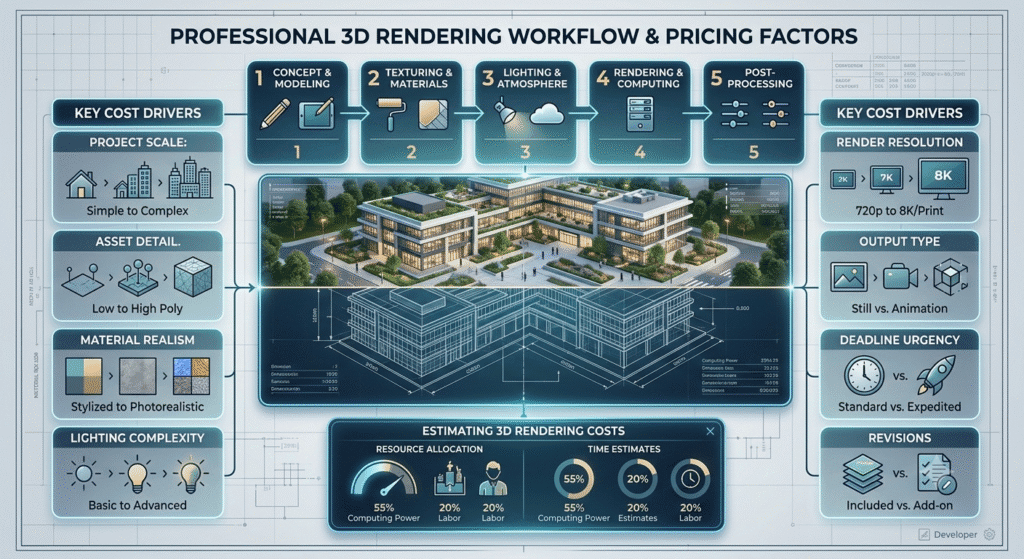
Another key factor affecting the cost of 3D rendering is project complexity. Multicomponent products, assembly parts, and complicated mechanical components require additional processing in order to render. More optimization and adjustment of light conditions can be needed in case of complicated engineering models in order to obtain good results.
Model Quality
The quality of the CAD model affects the efficiency of rendering considerably. High-quality digital models mean less work and fewer changes, which makes the process of rendering easier and faster. Speaking about 3D rendering cost, it is crucial to mention model quality as well, because high-quality engineering models will be easier to prepare and render.
Rendering Details
The quality of 3D rendering can be influenced by material, lighting, textures, reflections, and the realism of the rendered product. High-quality rendering means taking into account both visual quality and the goals of the project.
Product Visualization
Product visualization allows engineers and manufacturers to review product appearance before physical production. Digital images create realistic visuals that help communicate with clients, the project team, and the manufacturers. The second benefit besides lower 3D rendering costs is that realistic visualization allows making proper engineering decisions with no need to build numerous physical prototypes.
Engineering Communication
Professional rendering helps engineers to communicate because complicated products are presented visually. Thus, engineers, manufacturers, and other stakeholders get an opportunity to analyze product features using realistic digital images. Realistic visualization of the product facilitates the approval process and cooperation within the product development process.
Product Development
Professional rendering provides help during the product development process since engineers get an opportunity to see how the product looks using realistic visualization prior to its production. They may check appearance and make changes. When it comes to the question about the 3D rendering cost, the value of professional rendering should be considered too. Design HOK is best known for providing CAD services.
Manufacturing Support
Rendering plays an important role in manufacturing preparation by helping engineering teams review products before production. Visualization of a product in its realistic form helps in comprehending the structure, assembly, and design intent of a product. Professional rendering improves communication among the departments involved in engineering and manufacturing and is helpful in developing a good production strategy.
Efficiency in Workflow
An efficient rendering workflow reduces the timeframe of a project and improves cooperation among engineering teams. Good planning of CAD models, appropriate rendering parameters, and good reviewing process help in efficient visualization projects. Although the 3D rendering price differs depending on each particular project, an efficient workflow allows organizations to get maximum benefit from their investments.
Factors Affecting Price
There are many technical elements that impact the cost of 3D rendering services, including the complexity of the project, preparation of the model, resolution required during rendering, number of images required, need for changes, and deadlines. All these aspects vary depending on a specific project. Understanding these factors allows companies to plan their rendering projects efficiently.
Industry Applications
Professional 3D rendering solutions have been extensively applied in mechanical engineering, industrial machinery design, manufacturing processes, product design, automotive engineering, and machinery visualization. Engineering firms rely on realistic rendering solutions to facilitate product reviews, technical presentations, and manufacturing communications.
It becomes obvious from the industry uses provided above that firms assessing 3D rendering costs must take into account not only its immediate price but also the long-term benefits of enhanced engineering communication and product visualization capabilities.
Future of 3D Rendering
AI, real-time rendering, cloud computing, and visualization are impacting the future of engineering rendering technology. The latest technological advancements have helped to make rendering faster and more efficient. Due to constant technological developments in digital engineering, rendering solutions have become more efficient and at the same time high-quality.
Conclusion
Costing of 3D rendering includes many more things than just the pricing. The overall value of the service is dependent upon the complexity of the project, quality of models, visualization requirements, and engineering goals. Professional rendering adds value to communication about products, engineering, manufacturing preparation, and decision-making processes. For companies that are asking themselves, “How much does 3D rendering cost?” it is often worthwhile choosing a professional rendering solution that will provide high-quality visualizations.
FAQs
1. What do we mean by the 3D rendering cost?
“3D rendering cost” means the money that you will need to spend to obtain photo-realistic digital pictures of your product.
2. Why does the rendering cost differ?
The rendering cost depends on many parameters such as model complexity, rendering quality, revision, project scope, and others.
3. What influences the 3D rendering cost?
The primary drivers for rendering costs are the model level of detail, picture resolution, project size, and visualization needs.
4. Why should you opt for professional rendering?
Professional rendering leads to good-quality visualization & concept assessment prior to the actual manufacturing process.
5. How can rendering help the product?
Rendering allows engineers to evaluate the look of the product and improve it.
6. Does rendering help to reduce development costs?
Surely, the realistic visualization cuts down the quantity of design changes and prototypes.
7. In which industries is the rendering used?
The fields where rendering is widely applied are mechanical engineering, manufacturing, industrial machinery, the automotive industry, and the product development industry.
8. Is the model quality significant?
Certainly, high-quality CAD models make the visualization process more efficient and help to get better results from visualization.